Craniofacial Surgeon in Bengaluru
Specialist care for craniosynostosis and syndromic craniofacial anomalies, from a surgeon trained at the Oxford Craniofacial Unit and the Royal Children's Hospital Melbourne.
Book a Consultation
Understanding Craniofacial Anomalies
Craniofacial anomalies, also called craniofacial disorders or malformations, are a group of congenital conditions present at birth that affect the structure and development of the head and face. They can involve bone, soft tissue, or both, and range from mild cosmetic differences to severe functional and health concerns. The global incidence is about 1 in 20,000 live births, which means in a country like India around 30 children are born with a craniofacial condition every day. Early diagnosis and timely treatment allow these children to express their full potential.
Craniosynostosis
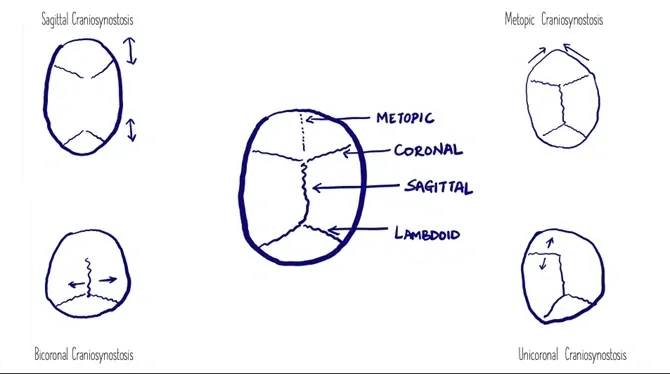
The skull is made of several bone plates separated by small gaps called cranial sutures. These sutures coordinate growth between the brain and the skull, and normally stay open into adulthood. Each person has two coronal sutures, two lambdoid sutures, one metopic suture and one sagittal suture.
Craniosynostosis is a rare congenital condition affecting about 1 in 3,000 children, in which one or more sutures fuse early during pregnancy. This can make the skull and head shape grow abnormally and, if left untreated, may occasionally cause raised pressure on the growing brain, leading to headaches and, in extreme cases, seizures and effects on vision and development. The specific suture that fuses produces a predictable head shape.
Craniofacial Conditions We Treat
The suture that fuses, or the syndrome involved, determines the head shape and the plan of care.
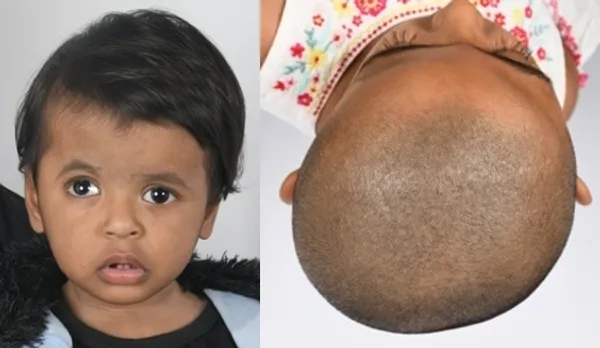
Sagittal Synostosis
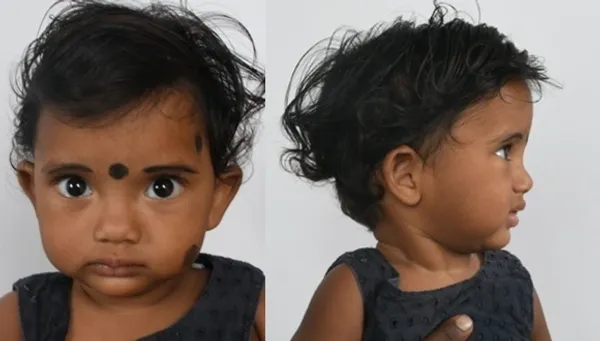
Fusion of the central suture running from one fontanelle to the other. The soft spot, normally diamond-shaped, is often triangular. The head is long from front to back and narrow side to side, with a prominent, bossed forehead and a pointed back of the head. It is one of the most common types of synostosis but is often misdiagnosed in India.
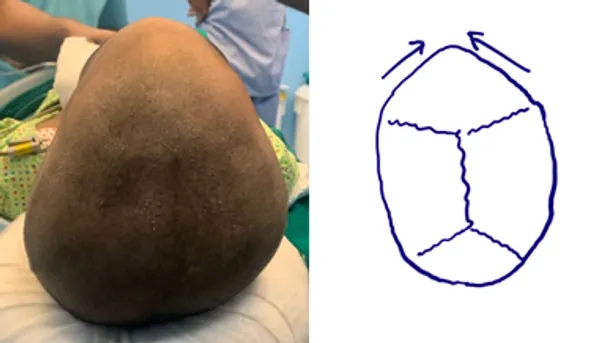
Unicoronal Craniosynostosis
Fusion of one of the two coronal sutures, causing flattening of the forehead on one side, known as plagiocephaly. The affected eyebrow is more elevated and the eye looks wider open, and from above the skull looks like a trapezium. The distance between ear and eye is shorter on the affected side, and the nose and chin deviate to the opposite side, causing facial asymmetry.
Metopic Craniosynostosis
Fusion of the growing line in the middle of the forehead. This is the second most common suture to fuse, occurring in about 1 in 10,000 live births and more often in boys. It gives a triangular forehead, called trigonocephaly, with a tendency for the eyes to appear closer together than normal.
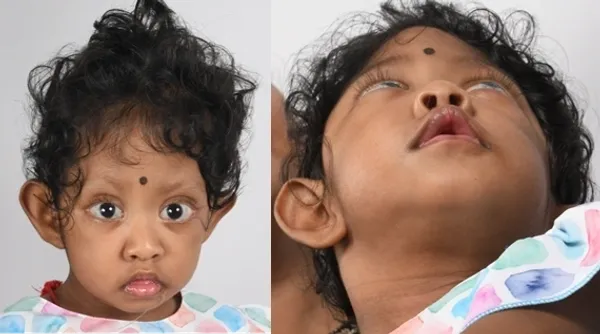
Syndromic Single Suture Synostosis
A single fused suture that also has a known associated gene. These conditions need detailed evaluation because they may come with other associated conditions, and the child often needs closer observation after surgery.
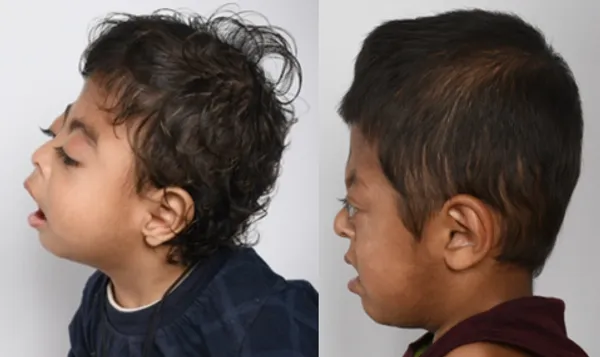
Bicoronal Craniosynostosis
Fusion of both coronal sutures, which is far more likely to be genetic in origin than single-suture types. The skull is broad and short from front to back with a flat forehead, called brachycephaly, or sometimes grows tall, called turricephaly.
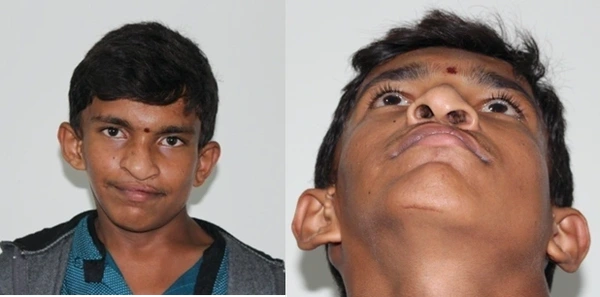
Hemifacial Microsomia
Affecting about 1 in 2,500 births, this is one of the most common craniofacial anomalies after cleft lip and palate. One side of the face is underdeveloped, causing asymmetry, and it can involve the eye socket, ear, lower jaw, facial soft tissue and the nerve to the facial muscles. Timing of surgery matters, and the right treatment algorithm improves outcomes. A child born with ear tags or a deformed ear needs a detailed examination for this condition.
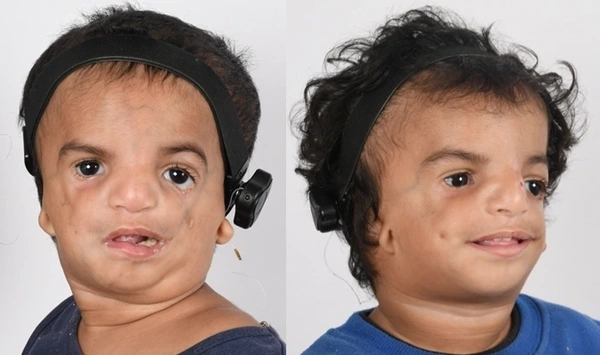
Treacher Collins Syndrome
A genetic birth disorder affecting the shape of the head and face, in which most children are of normal intelligence. Common features include down-slanting eyes, underdeveloped or absent cheekbones, a small lower jaw, underdeveloped or unusually formed ears, and sometimes a cleft palate.
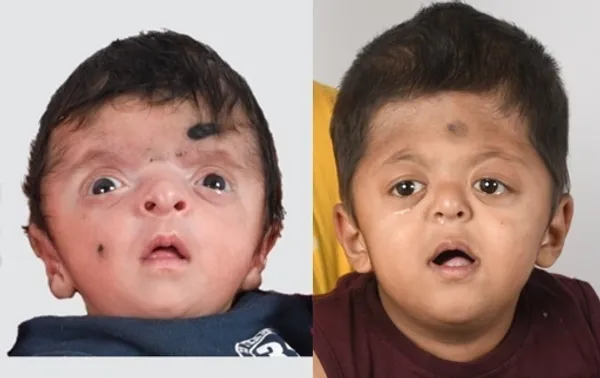
Apert Syndrome
A rare genetic syndromic craniosynostosis occurring in about 1 in 65,000 live births, combining craniofacial and limb differences. Features include brachycephaly from bicoronal synostosis, shallow eye sockets that make the eyes look bulging, and poor midface growth with an underdeveloped upper jaw and possible sleep apnoea. Some cases have a cleft palate. The hands and feet show complex symmetrical syndactyly (fused fingers and toes), which needs a specialist hand surgeon working with the craniofacial team.
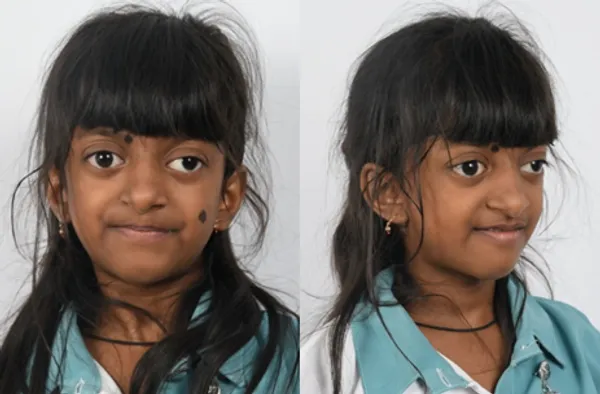
Crouzon Syndrome
A rare genetic syndromic craniosynostosis occurring in about 1 in 60,000 live births. Features, which range from mild to severe, include brachycephaly from bicoronal synostosis, shallow eye sockets (exorbitism) that make the eyes appear bulging, and poor midface growth with an underdeveloped upper jaw and possible sleep apnoea. The limbs are essentially normal, and individuals usually have normal intelligence.
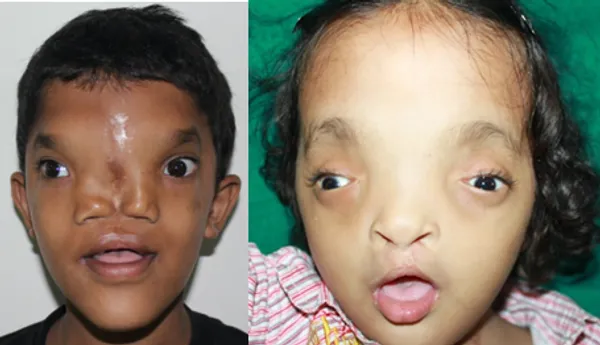
Hypertelorism
Also known as orbital hypertelorism, this is an abnormally increased distance between the orbits, the bony sockets that hold the eyes. It can be associated with different syndromes, and the treatment is designed around how it presents in each child.
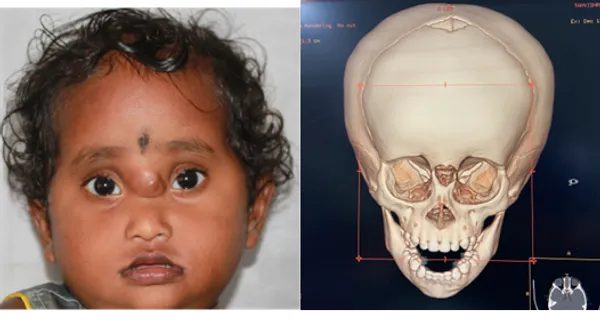
Encephaloceles
A sac-like protrusion of the brain and its covering membranes through an opening in the skull. The craniofacial surgeon works with the neurosurgeon to close the bony defect and to address any displacement of the eye socket that may be present.
Are Craniofacial Anomalies Curable?
For some craniofacial anomalies, such as minor cleft lip or palate, surgery is very effective and the outcome is often excellent, restoring function and appearance. These are usually done early in a child's life, and with proper care and follow-up the child grows up with minimal ongoing issues.
More complex anomalies, such as certain types of craniosynostosis or severe facial asymmetry, may need several surgeries over a longer period to achieve the best result. A team of experts from different fields works together so these children can fully express their potential.
Minimally Invasive Strip Craniectomy and Helmet Remoulding
For selected babies diagnosed early, a minimally invasive strip craniectomy with helmet remoulding can correct craniosynostosis, including unicoronal and metopic synostosis, through a small incision. The fused suture is released, and a custom helmet then guides the skull into a normal shape as the brain grows. The advantages are less blood loss, a shorter hospital stay and a small scar.
The ideal timing for this approach is 3 to 5 months of age, with limited benefit possible up to 7 months. Because the correction relies on continued brain growth to remould the skull, there is a risk of suboptimal correction depending on the severity, which may need a further procedure at a later date.
Where a child presents later, the skull is corrected by remodelling using the bones of the skull. The ideal timing for this is 9 to 15 months of age, with good results still possible up to 24 months. Beyond this it is best to discuss with Dr Rao how the type of fusion and the remodelling may affect the outcome. In every case, the balance of both aesthetics and function is important, and Dr Rao's aim is to leave no tell-tale signs of the initial presentation. This philosophy helps achieve the best possible outcome despite the extensive nature of the surgery.
Pierre Robin Sequence (PRS)
At Bhagwan Mahaveer Jain Hospital, Bangalore, Dr Rao and his colleagues have developed a conservative-first approach to the management of Pierre Robin Sequence. The classic triad of PRS is micrognathia (a small, set-back lower jaw), glossoptosis (the tongue falling back) and upper airway obstruction, and these children may also have a cleft palate.
The team assesses the degree of apnoea and tongue fall and, based on the findings, offers management ranging from positioning (sleeping on the side rather than the back), to a nasopharyngeal airway (a small breathing tube in the nose that bypasses the tongue-related obstruction), to, in some cases, mandibular distraction osteogenesis using an internal distractor device. The unit has one of the best prognoses with this protocol, with complete resolution of symptoms in most children.
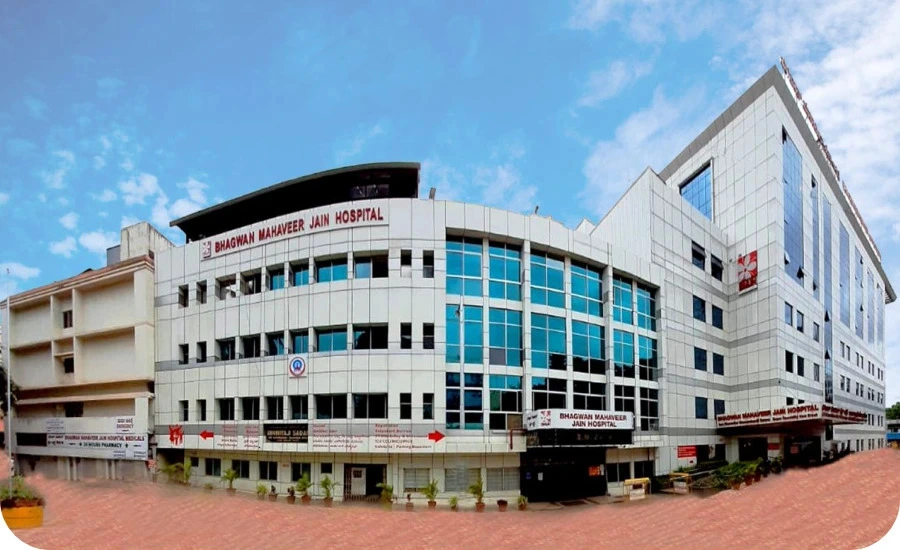
Bhagwan Mahaveer Jain Hospital, a Right Place for Craniofacial Care
Craniofacial care is considered one of the most challenging fields and is offered only in highly specialised units. The United Kingdom, for example, has just four centres for the whole country. In India care is scattered, with very few teams able to handle these conditions regularly.
At Bhagwan Mahaveer Jain Hospital the right team is in place, built on the track record of the Smile Train Project run here for the last 18 years, which funds cleft surgery, dental care, nutrition, speech therapy and clinical psychology free of cost. In recognition of this work, Smile Train granted Cleft Leadership Center status, the only such unit in India and one of only seven in the world.
Why Choose Dr Dipesh Rao
Dr Dipesh Rao is a craniofacial and oral and maxillofacial surgeon in Bengaluru who completed a fellowship in craniofacial surgery at the Oxford Craniofacial Unit, one of the United Kingdom's four national craniofacial centres, and a paediatric maxillofacial fellowship at the Royal Children's Hospital Melbourne. Very few surgeons train in both fields. He provides craniosynostosis and syndromic craniofacial care within a multidisciplinary team at Bhagwan Mahaveer Jain Hospital, guiding families from early diagnosis through to adulthood, and consults in English, Hindi and Kannada.
Frequently Asked Questions
What is craniofacial surgery?
Craniofacial surgery treats complex conditions of the skull, face and jaws, most often present from birth, and needs both soft-tissue and hard-tissue procedures. It includes reshaping the skull in craniosynostosis, advancing the midface in syndromic conditions, and correcting facial deformity, to restore both function and appearance.
What is a craniofacial surgeon?
A craniofacial surgeon is a specialist with specific training who corrects deformities of the skull, face and jaws within a multidisciplinary team. Dr Dipesh Rao trained at the Oxford Craniofacial Unit and the Royal Children's Hospital Melbourne.
What is craniosynostosis?
Craniosynostosis is the early fusion of one or more of the sutures between the plates of a baby's skull, affecting about 1 in 3,000 children. Because the skull cannot grow normally across a fused suture, the head takes on a predictable unusual shape, and in some cases pressure can build inside the skull.
How is craniosynostosis diagnosed?
It is often noticed from the head shape in the first months of life and confirmed with examination and imaging such as a CT scan. Signs include a ridge along a suture, a very early closing soft spot, and a head shape that does not improve with position changes.
At what age is craniosynostosis treated?
Timing depends on the suture involved and the child's health. Many procedures are carried out in the first year of life to give the brain room to grow and to guide head shape, with the plan tailored to each child by the craniofacial team.
What are Apert, Crouzon and Treacher Collins syndrome?
These are genetic craniofacial conditions. Apert and Crouzon are syndromic craniosynostoses with early fusion of skull sutures, shallow eye sockets and midface underdevelopment; Apert also involves fused fingers and toes. Treacher Collins affects the cheekbones, jaw and ears, usually with normal intelligence.
What is hemifacial microsomia?
Hemifacial microsomia is underdevelopment of one side of the face, affecting about 1 in 2,500 births. It can involve the eye socket, ear, lower jaw, soft tissue and facial nerve. A child born with ear tags or a deformed ear should be examined for this condition, and the timing of surgery is important.
Are craniofacial anomalies curable?
Simple anomalies such as minor cleft are corrected very effectively with early surgery and excellent outcomes. Complex anomalies such as certain craniosynostoses or severe facial asymmetry may need several surgeries over time, with a multidisciplinary team helping the child reach their full potential.
Is craniofacial surgery safe?
Modern craniofacial surgery is well established and, in experienced hands with a multidisciplinary team, has a strong safety record. Careful planning with three-dimensional imaging and close monitoring keep risks low, and Dr Rao discusses these fully with every family.
Who should perform craniofacial surgery?
It should be carried out by a fellowship-trained craniofacial surgeon working within a multidisciplinary team. Dr Dipesh Rao trained at the Oxford Craniofacial Unit and Royal Children's Hospital Melbourne and provides craniosynostosis and syndromic care in Bengaluru.
What is the ideal age for minimally invasive strip craniectomy with helmet remoulding?
The ideal timing is 3 to 5 months of age, with limited benefit possible up to 7 months. It offers less blood loss, a shorter hospital stay and a small scar, but carries a risk of suboptimal correction depending on severity, which may need a further procedure later. Correction using the bones of the skull is best done between 9 and 15 months, with good results still possible up to 24 months.
What is Pierre Robin Sequence and how is it treated?
Pierre Robin Sequence is the triad of a small, set-back lower jaw (micrognathia), the tongue falling back (glossoptosis) and upper airway obstruction, sometimes with a cleft palate. Dr Rao's team uses a conservative-first approach: positioning, a nasopharyngeal airway, or, in some cases, mandibular distraction osteogenesis, with complete resolution of symptoms in most children.
Can I choose private-room care with Dr Rao?
Yes. Dr Rao treats private patients in private rooms at Bhagwan Mahaveer Jain Hospital, with the same standard of comfort and hygiene you would expect from a private hospital. Because the unit also manages a very high volume of complex cleft and craniofacial cases, families benefit from refined surgical skill and a complete multidisciplinary team under one roof.
Speak With a Craniofacial Surgeon in Bengaluru
Early assessment gives the best outcomes. Book a consultation with Dr Dipesh Rao.
WhatsApp +91 99013 02211